ALDAR/ Iman Alaoui
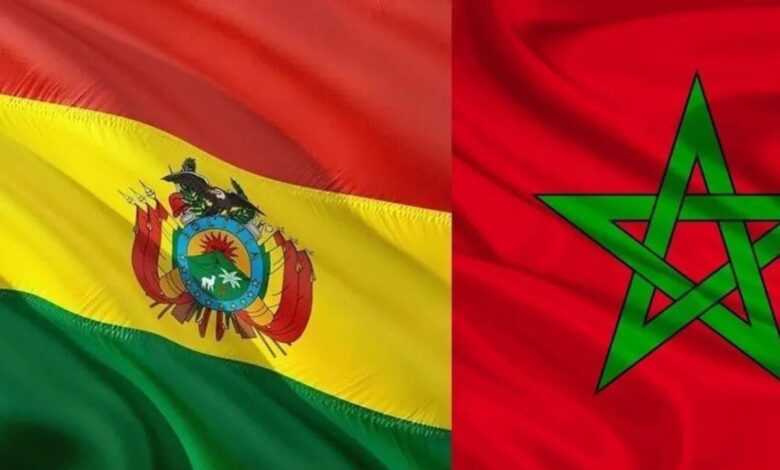
Bolivia and Morocco have announced the opening of a new chapter in their bilateral relations following a phone conversation on February 23, 2026, between Bolivia’s Minister of Foreign Affairs Fernando Aramayo and Morocco’s Minister of Foreign Affairs, African Cooperation and Moroccan Expatriates Nasser Bourita. The exchange reflects a shared commitment to strengthening political and economic cooperation between the two countries.
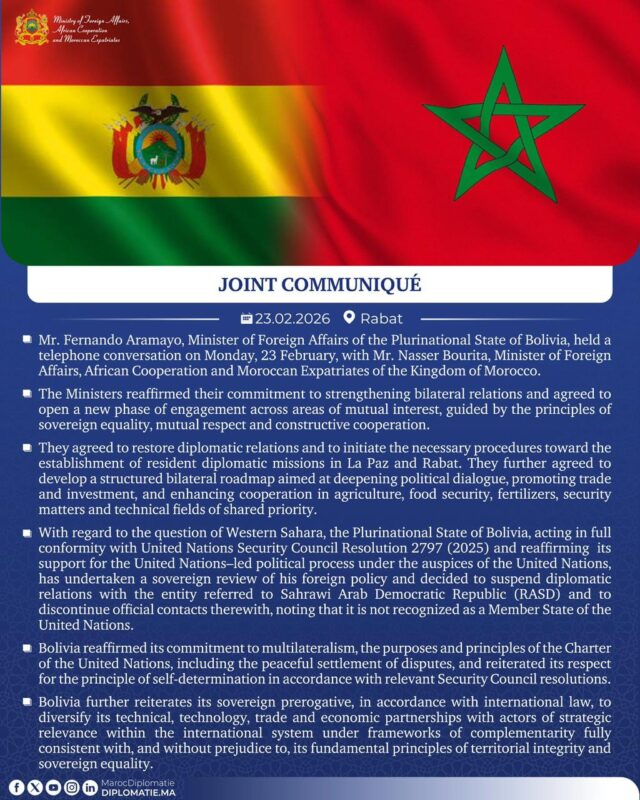
According to a joint statement issued in Rabat, both ministers reaffirmed their determination to reinforce bilateral relations and open a new phase of partnership across several areas of mutual interest. This renewed cooperation will be based on the principles of sovereign equality, mutual respect and constructive collaboration.
In this context, the two sides agreed to restore diplomatic relations and initiate the necessary procedures to establish resident diplomatic missions in La Paz and Rabat. They also plan to develop a structured bilateral roadmap aimed at deepening political dialogue, boosting trade and investment, and expanding cooperation in key sectors such as agriculture, food security, fertilizers, security issues and priority technical fields.
Regarding the Moroccan Sahara issue, Bolivia stated that, in line with the resolutions of the United Nations Security Council and its support for the political process led by the United Nations, it had conducted a sovereign review of its foreign policy. As a result, La Paz decided to suspend its diplomatic relations with the entity known as the “Sahrawi Republic” (RASD) and to cease all official contacts with it, emphasizing that this entity is not recognized as a member state within the United Nations.
Bolivia also reiterated its commitment to the principles of multilateralism and respect for the purposes and principles of the UN Charter, particularly those related to the peaceful settlement of disputes. At the same time, it reaffirmed its respect for the principle of self-determination in accordance with relevant Security Council resolutions.
Furthermore, La Paz stressed its sovereign right, in accordance with international law, to diversify its technical, technological, commercial and economic partnerships with strategic actors within the international system. This approach is based on complementarity and aligns with its fundamental principles concerning territorial integrity and sovereign equality among states.
This decision represents a significant diplomatic shift in Bolivia’s position and opens new prospects for Morocco–Latin America cooperation, amid a growing international momentum supporting a realistic approach to resolving the regional dispute over the Sahara under the auspices of the United Nations.